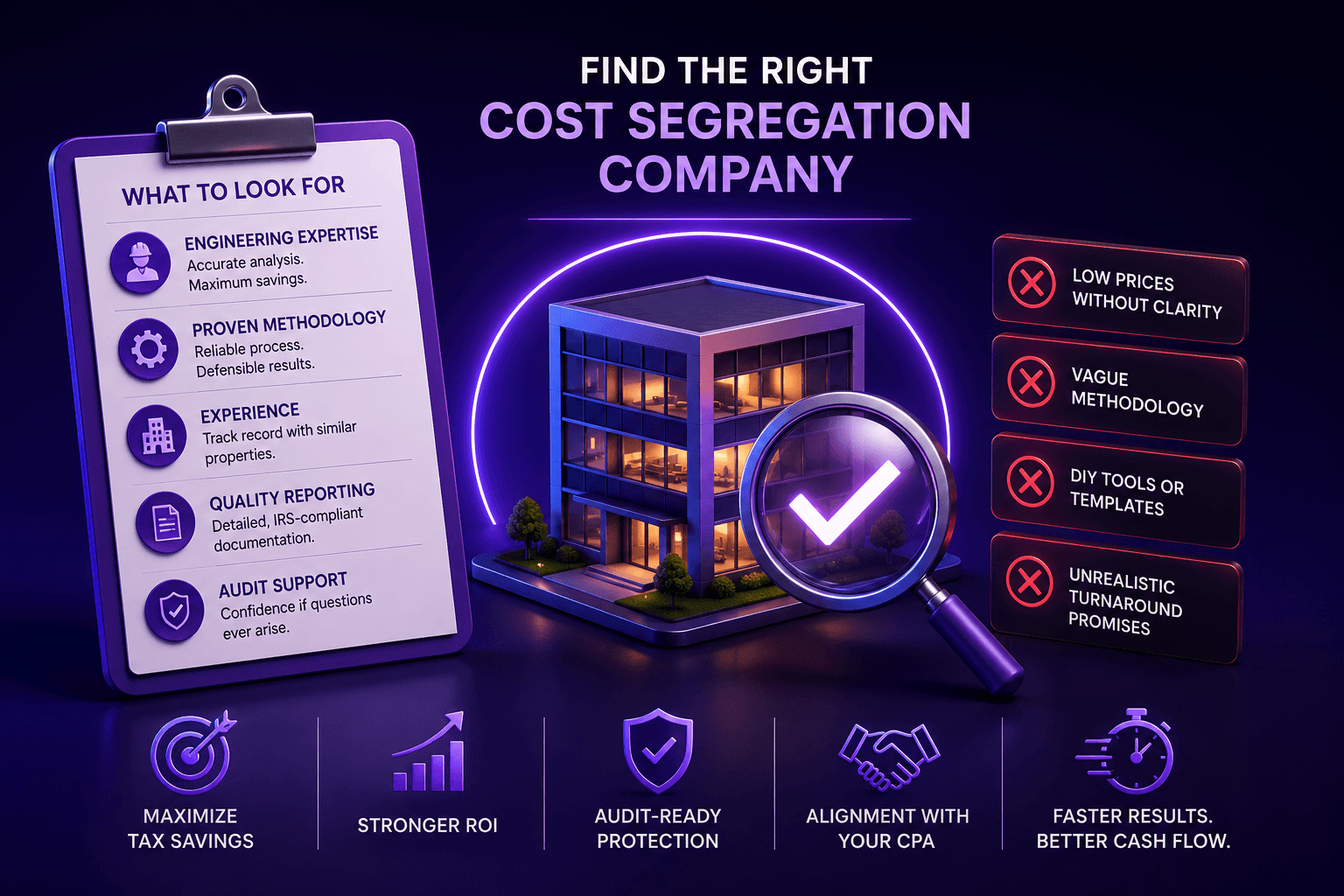

Best Cost Segregation Services: What to Look for Before You Hire
This guide is for real estate investors, property owners, and tax professionals seeking to maximize tax savings through cost segregation. Choosing the right cost segregation service can significantly impact your tax liability and cash flow. The best cost segregation services do more than offer a low fee: they pair engineering expertise, strong documentation, and experience with properties like yours to produce accurate, IRS-defensible studies that maximize depreciation and reduce audit risk.
Cost segregation identifies assets for shorter depreciation periods. Cost segregation services allow commercial property owners to accelerate depreciation deductions. For commercial or residential real estate investors with income-producing properties, and for CPA firms or tax advisory practices that need audit-ready studies without adding engineering staff, the provider you choose directly affects how much tax savings you realize and how well the study fits into your broader tax strategy.
In most cases, this decision is made in coordination with your CPA, who helps evaluate methodology, documentation quality, audit support, and the timing of depreciation benefits.
Many investors assume all cost segregation firms deliver similar results. That assumption often leads to missed deductions, weak documentation, and unnecessary audit risk. The difference between an average provider and a high-quality firm shows up in both the numbers and the level of support behind them, which is why this guide focuses on how to compare cost segregation companies, what to look for in their engineering approach and reporting, how tax savings strategies and audit readiness differ, and what makes providers like Segtax stand out.
What Makes the Best Cost Segregation Companies Stand Out?
Not all cost segregation services are built the same. The best providers combine technical expertise with a strong understanding of tax strategy.
Top firms do more than deliver a report. They ensure property components are classified accurately under IRS guidelines, properly documented, and aligned with tax law.
A high-quality study reflects both engineering precision and tax awareness, since the IRS generally prefers an engineering-based methodology. Without both, results may be incomplete or difficult to defend.
Cost segregation identifies assets for shorter depreciation periods, which is essential for maximizing tax benefits. Cost segregation services allow commercial property owners to accelerate depreciation deductions, resulting in immediate and significant tax savings.
Why Engineering Expertise Matters
A cost segregation study is fundamentally an engineering-based analysis.
Firms that rely on engineers or technical specialists are better equipped to identify components that qualify for shorter recovery periods by reclassifying building components into personal property and other shorter-life assets. This accelerates depreciation deductions and increases overall tax savings; bonus depreciation can also apply when those assets have a useful life under 20 years. This directly impacts how much of the property can be accelerated into 5, 7, or 15-year categories.
Less technical approaches often rely on estimates or standardized models, which can limit accuracy and reduce total tax savings.
Why Methodology Matters
Methodology plays a major role in both accuracy and consistency.
Some firms use technology-enabled approaches to streamline analysis, while others rely more heavily on manual data entry inputs, which can introduce variability and increase the risk of human error. The key is whether the process supports accurate classification and strong documentation through careful cost segregation work.
Good methodology often includes an engineering analysis and, when needed, a site visit or detailed visual or virtual review to improve accuracy in the segregation work. A well-defined methodology ensures each asset is properly evaluated and that the process produces a detailed engineering-based analysis that can withstand IRS review, which the IRS generally expects for cost segregation studies.
What to Look for in Cost Segregation Services
Choosing the right provider requires looking beyond surface-level claims.
Experience With Similar Properties
A firm that regularly works with your property type—whether commercial properties such as office buildings, retail centers, and industrial facilities, or residential properties used as an investment property—is more likely to identify all eligible components and maximize depreciation. Firms with relevant experience are especially helpful for qualified property, including owners constructing or acquiring commercial real estate, properties purchased, constructed, or renovated in the last 10–15 years, and assets with substantial improvements.
Documentation Quality
A strong report should clearly explain asset classifications, and the final report should document recovery periods such as 5, 7, or 15 years, tie those classifications to updated depreciation schedules, and provide a solid audit trail for the IRS. Clear documentation is especially important when claiming bonus depreciation on qualified improvements, and its quality matters more than simply choosing the lowest fee.
Communication and Process
A reliable provider should clearly explain their methodology and integrate smoothly with your CPA's workflow. They should also spell out any preliminary estimate or feasibility analysis before the study begins, including what property details and purchase price documents they need and whether the early review suggests the work is worthwhile.
How to Compare Cost Segregation Firms
Comparing firms requires focusing on what actually impacts results, including whether the property has enough basis—often around $300K—to justify the study. For a deeper look at how studies are structured and evaluated, review Cost Segregation Study for Residential Rental Property.
Pricing matters, but it should not be the primary decision driver. Lower-cost, engineering-based studies are available, particularly with firms that take a technology-forward approach. However, it is important to evaluate the accuracy of the analysis, the quality of the supporting documentation, and the potential tax savings.
In many cases, low-cost providers and DIY tools rely on simplified methods or shortcuts that do not deliver a true engineering-based analysis, which can expose taxpayers to audit risk and leave money on the table.
Instead, evaluate methodology, report detail, and relevant experience. Also consider what is included in the service, such as support after delivery, how the work may reduce tax liability, and whether it can increase cash flow. That matters for real estate investments focused on improving cash flow, and properties generating significant cash flow usually have more to gain from a high-quality study.
Red Flags to Watch For
Certain warning signs can indicate a lower-quality provider. Watch for these red flags:
Unclear or vague methodology
DIY or self-service tools often lack detailed documentation
Initial estimates that are vague or lack supporting assumptions
No clear audit defense or post-study audit support, which is essential for a reliable provider
Promises of unusually fast turnaround without explanation, especially without a proven track record
Reviewing a sample report before hiring can help identify these issues early.
How Top Firms Maximize Tax Savings
The best cost segregation companies focus on both accuracy and strategy.
Accurate classification ensures all eligible components are identified, which helps commercial property owners accelerate depreciation deductions, unlock immediate tax savings, support deferring taxes, and improve near-term cash flow.
Strategic alignment ensures those deductions are used effectively to reduce current tax liability based on your income, investment goals, and overall taxes.
Firms that coordinate with tax professionals provide more value than those that operate in isolation.
Why Audit Support Matters
Audit support is often overlooked but plays a key role in long-term value. To understand what happens if a study is reviewed, see The IRS Audit Guide to Cost Segregation.
A well-prepared study should include documentation that supports classifications and methodology, prepared by qualified professionals under engineering standards; credentials such as Certified Cost Segregation Professionals (CCSPs) can help demonstrate competence. Some firms also provide audit support if questions arise later, along with IRS-compliant engineering expertise for questions tied to tax returns.
Understanding what is included reduces risk and increases confidence in the results.
Why Investors Choose SegTax
SegTax is built to modernize the cost segregation process while maintaining high-quality, audit-ready results.
Frictionless process from start to finish with minimal time required from the investor
Delivered in 1 to 6 weeks depending on property size and documentation
Costs 25 percent to 50 percent less than traditional providers while maintaining engineering-based accuracy
This allows investors to capture maximum tax savings faster, more efficiently, and at a lower cost without sacrificing quality.
Feature | SegTax | Traditional Firms |
|---|---|---|
Process | Frictionless, minimal input required from investor | Often manual, requires back-and-forth and heavy documentation |
Timeline | Delivered in 1 to 6 weeks | Typically 4 to 12+ weeks depending on complexity |
Cost | 25% to 50% lower on average | Higher fees due to overhead and manual processes |
Methodology | Technology-enabled with engineering oversight | Often fully manual or reliant on on-site visits |
Accuracy | Engineering-based and audit-ready | Varies by firm and methodology |
Communication | Streamlined and easy to integrate with CPA workflow | Can be fragmented depending on team structure |
Scalability | Built to handle multiple properties efficiently | Can slow down significantly with portfolio growth |
ROI Focus | Optimized for speed, cost efficiency, and usable deductions | Often focused on report delivery rather than strategy |
How to Choose the Right Cost Segregation Company
The right provider depends on your property, tax situation, and investment strategy.
Larger or more complex properties may benefit from deeper engineering involvement, while simpler properties still require accurate classification and strong documentation.
Evaluating methodology, experience with cost seg studies, broader tax services, and report quality together provides a clearer decision framework for cost seg than focusing on price alone, including whether the firm offers a preliminary estimate before engagement and whether the documentation quality justifies the fee.
Ready to Choose the Right Cost Segregation Partner?
Choosing the right provider directly impacts both the quality of your study and the tax savings it produces.
A well-executed cost segregation analysis should improve cash flow, reduce taxable income, and provide documentation that supports long-term compliance; for many property owners, the potential tax savings can range from roughly $50,000 to $1M+ in taxes, with average savings often exceeding $250,000 per property depending on the asset and study scope.
SegTax combines engineering expertise with a streamlined, cost-efficient approach to deliver accurate, audit-ready studies that help real estate investors maximize tax savings.
For additional guidance on evaluating providers, you can review Green Flags and Red Flags: How to Choose a Cost Segregation Firm.
What are the best cost segregation companies?
What are the best cost segregation companies? The best firms combine engineering expertise, strong documentation, and experience with similar property types.
How do you compare cost segregation firms?
How do you compare cost segregation firms? Focus on methodology, experience, report quality, and audit support rather than price alone.
Are all cost segregation services the same?
Are all cost segregation services the same? No. Differences in methodology and expertise can significantly impact both accuracy and tax savings.
Why is engineering expertise important?
Why is engineering expertise important? It ensures accurate asset classification, which directly impacts the amount of accelerated depreciation. Proper classification also affects eligibility for bonus depreciation and other tax benefits.
Do cost segregation companies provide audit support?
Do cost segregation companies provide audit support? Some firms include audit support, which can be valuable if the study is reviewed later.
What is the current bonus depreciation rule?
What is the current bonus depreciation rule? Bonus depreciation allows 100% deduction of qualifying property costs, and 100% bonus depreciation applies to property placed in service after January 19, 2025. For property placed in service before January 19, 2025, the prior phase-down schedule remains in effect. The One Big Beautiful Bill Act reinstated permanent 100% bonus depreciation.
Cost Segregation Depreciation vs Straight-Line Depreciation: What's the Difference?